
$20.00
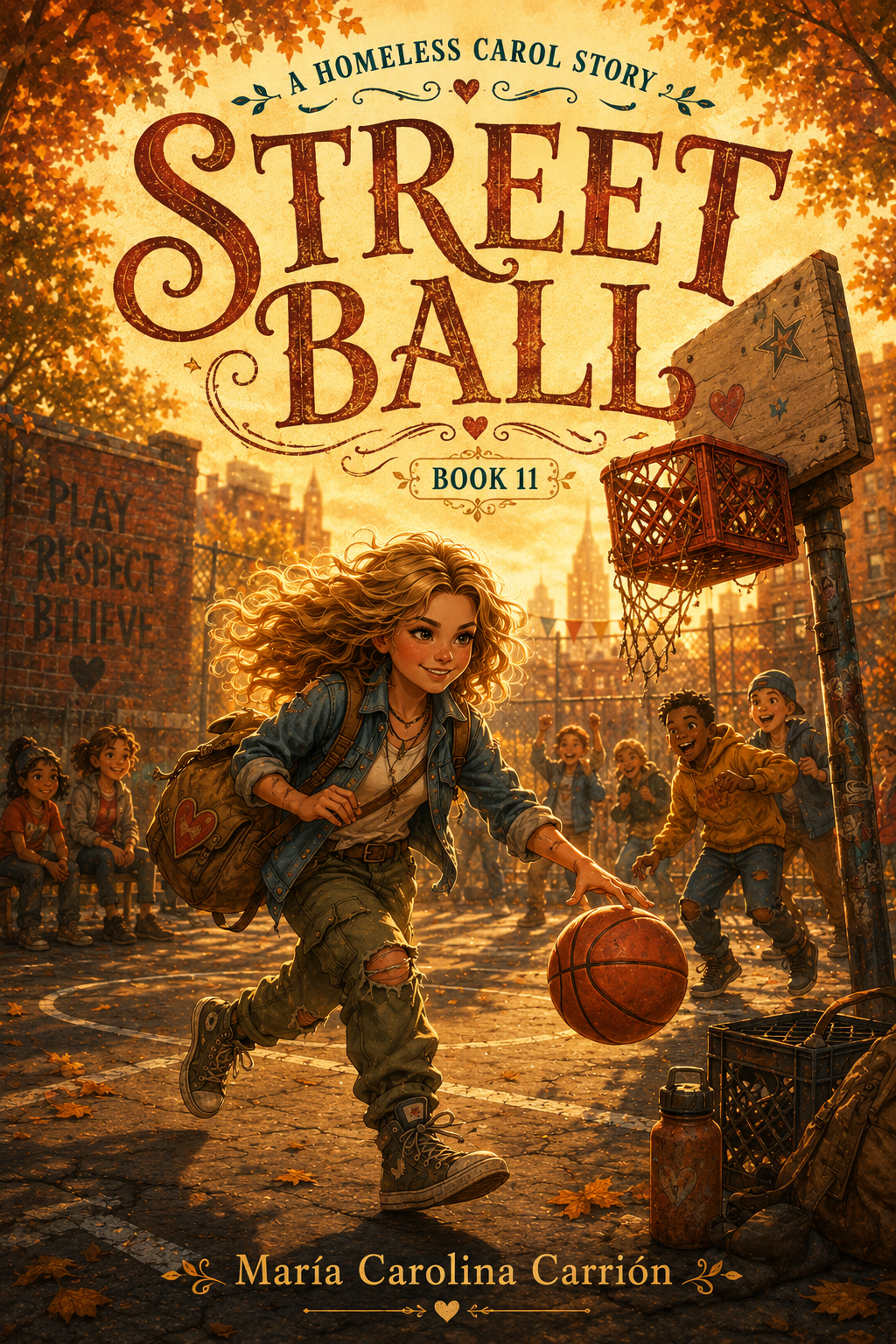
A cracked neighborhood court and a makeshift hoop become the setting for a powerful lesson about effort, fairness, resilience, teamwork, and playing with integrity.
In Street Ball, Carol and her friends discover that real success is not only about making the shot. It is also about how you play, how you respond when things go wrong, and whether you keep going when nobody is there to make the rules for you.
Availability:
In StockWhat happens when there is no referee, no perfect court, and no one else to decide what is fair?
In Homeless Carol — Book 11: Street Ball, Carol and her friends turn a cracked pavement court and a milk-crate hoop into their own neighborhood basketball game.
There are no officials.
No polished uniforms.
No perfect equipment.
And no adult standing nearby to settle every disagreement.
The children must decide for themselves how the game will be played.
Some bend the rules when they think nobody notices.
Some admit their own mistakes even when no one else saw them.
Some avoid taking risks.
Some repeat the same safe move until they are exhausted.
Some perform only when an audience is watching.
Others become so focused on fairness that they forget to keep playing.
Then Milo faces the most difficult shot on the court.
He falls.
He scrapes his hands.
He gets back up.
And he tries again.
Through every pass, foul, missed shot, and second chance, Carol and her friends learn that character matters most when there is no referee watching.
Street Ball transforms a neighborhood basketball game into a meaningful story about resilience, honesty, courage, resourcefulness, and the responsibility of creating fair rules together.
Integrity
Doing what is right even when no referee or adult is watching.
Resilience
Recovering from mistakes, falls, and disappointment.
Resourcefulness
Creating opportunities with the materials and spaces available.
Fairness
Building rules that allow everyone to participate with respect.
Courage
Taking the difficult shot even when failure is possible.
The neighborhood court becomes more than a place to play.
It becomes a place where the children must practice self-control, honesty, communication, and responsibility.
Without someone else enforcing the rules, every player must decide what kind of teammate and person they want to become.
Carol helps the group understand that winning a game means very little if trust is lost along the way.
Ages 7–12, with valuable lessons for families, educators, coaches, mentors, and young athletes.
You do not need a perfect court to begin.
You do not need perfect equipment to improve.
And you do not need to make every shot to become stronger.
Play with integrity. Get back up. Take the shot again.


Reviews
There are no reviews yet.